For those intimidated by the Pilates Reformer or currently lack the foundational body strength to successfully practice Mat Pilates, Chair Pilates offers a low-impact path to better strength and flexibility for anyone who finds the more traditional or popular ways of practicing Pilates unapproachable, uncomfortable, or simply out of reach. Whether you're currently living with limited mobility, slowly recovering from injury, or simply spending too many hours at a desk and want a change, a single chair can easily become the only equipment you need to become a better you. Our guide breaks down what Chair Pilates is, how the Wunda Chair came to be and how it works, and why it's worth trying.
What is Chair Pilates?
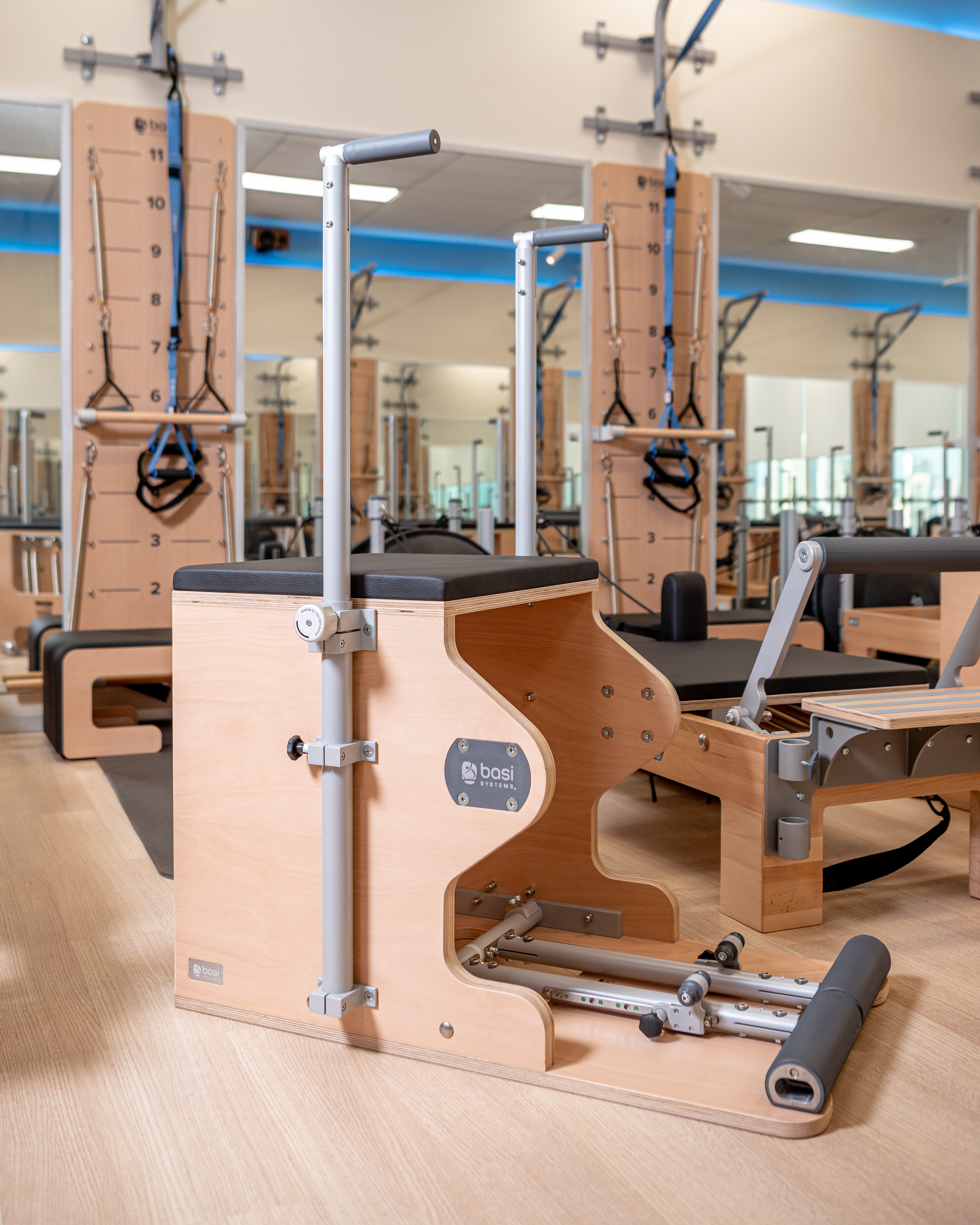
Chair Pilates is a form of Pilates done on a tool called the ‘Wunda Chair’. The Wunda Chair is a small and cube-shaped apparatus that looks like a backless chair. It’s designed with a padded seat and a spring-loaded pedal. This allows Pilates practitioners to use it to build full-body strength, core stability, and balance all from the comfort of their home or at a Pilates studio. Unlike the Pilates Reformer, the Wunda Chair takes up less space but still allows for a similar functionality and a variety of workouts.
The Wunda Chair is truly uncomplicated and appropriate to use for people recovering from injuries or those who have limitations. This Pilates apparatus is often used to correct muscle imbalances and assist in knee, hip, or lower limb rehabilitation. It is done through controlled, isolated movements. Training using the Wunda Chair is highly effective for stability or unilateral movements that could be beneficial for activities like running, golf, or even racquet sports.
However, despite being smaller than the Reformer machine, the Wunda Chair actually offers more of a challenge than the Pilates Reformer. As it doesn't assist with alignment and provides a much smaller base of support, a member has to use core engagement, balance, and stabilizing muscles to execute exercises. This targets smaller muscle groups and prevents stronger muscle areas from overcompensating, making the exercise feel much more intense and humbling. In fact, at Club Pilates, the Chair Pilates is only introduced to members in a Level 1.5 class, and can only experience a more full-body Chair Pilates workout in a Level 2 class. This is so that members have the foundational core strength to execute the exercises, ensuring they not only have good posture and also the confidence to carry out more advanced movements.
About The Wunda Chair
The Wunda Chair was invented in the 1930s by the father of Pilates, Joseph Pilates. In its original form, it’s a piece of furniture that can double as a tool for exercise. Portable and compact, it was designed so that his clients could bring it to their summer houses and maintain a healthy fitness routine. The idea behind the invention was that it could easily be turned into a contraption that could provide a workout for the entire body. With its multifunction, it eliminated people making excuses for having no time and little space for exercise equipment.
To convert the Wunda Chair from a piece of furniture to an exercise contraption, a person simply had to flip it over and attach the inner springs to the hooks. By doing this, what was once the seat of the chair now became a spring-loaded pedal that could be used for dozens of exercises for the whole body. Till this day, nearly one hundred years later, the Wunda Chair continues to be an essential in Pilates studios around the world. It ensures that Pilates practitioners can experience exercises just as its creator intended.
Benefits of Chair Pilates
Chair Pilates is great for helping a person improve their balance, build core strength, and increase their flexibility without putting stress on the joints. The beauty of using the Wunda Chair for Pilates is that it can be modified for people of all fitness levels and abilities. It provides a safe and stable environment to enhance mobility. Here are some benefits of practicing Chair Pilates for seniors:
- Low-Impact Strength Training: Movements done on the Wunda Chair are joint-friendly. They are carefully controlled to avoid the high impact of weight-bearing exercises, which can help reduce stiffness and pain in the body, especially if you have arthritis.
- Reduces Risk of Injury: Pilates builds strength in the abdominal, lower back, and pelvic floor muscles. It helps you build a stronger center of gravity, which can help reduce risk when experiencing a fall.
- Better Flexibility: With intentional and repetitive stretches done in the seated position, practitioners develop better range of motion in the spine, shoulders, and hips.
- Improved Posture: Pilates builds strength in the upper back and core. This can help ease slouching, reducing lower back pain and quality of life.
- Enhanced Mental Well-Being: Like traditional Pilates, the Chair Pilates practices controlled and mindful breathing, which lowers stress, promotes relaxation, and improves focus.
Age with Grace When You Practice Pilates
At Club Pilates, we believe that no matter your age or your fitness level, a consistent Pilates practice improves your posture, strengthens your core, and addresses muscle imbalances. Together, it creates a strong foundation for movement and aims to support a balanced, more fulfilling life for everybody. If you’re interested in trying Chair Pilates, visit our Pilates studio in Bangkok for an introductory class designed for all fitness levels. We’ll walk you through the Pilates basics and help familiarize you with the specialized studio equipment.
Call us at 02 286 1430 to reserve a spot at our session ahead of time. We’re located just a short walk from Lumphini MRT station, located on the 18th floor of the Grande Centre Point (WorkLab). We look forward to welcoming you and transforming your life with the beautiful practice of Pilates.
- LINE: https://lin.ee/g8rsIG0
- Tel: 061-894-6352 / 061-894-6152 / 02-286-1430
- Facebook: www.facebook.com/clubpilatesinthailand
- Instagram: www.instagram.com/clubpilatesthailand